Showing posts with label Wargame Rules. Show all posts

Wednesday, December 3, 2014

Carnage & Glory II: Fatigue


In preparing for the Quatre Bras game I needed to test out fatigue recovery rates, as the Anglo-Allies marched long distances to get to Quatre Bras.  I didn't want to reduce playabilty with the reinforcements arriving on the field and unable to act or have combat value.


Nigel (C&G II author extraordinaire)  has indicated that fatigue recovery is random from 0-24% which matches the variance seen above.

Friday, July 26, 2013

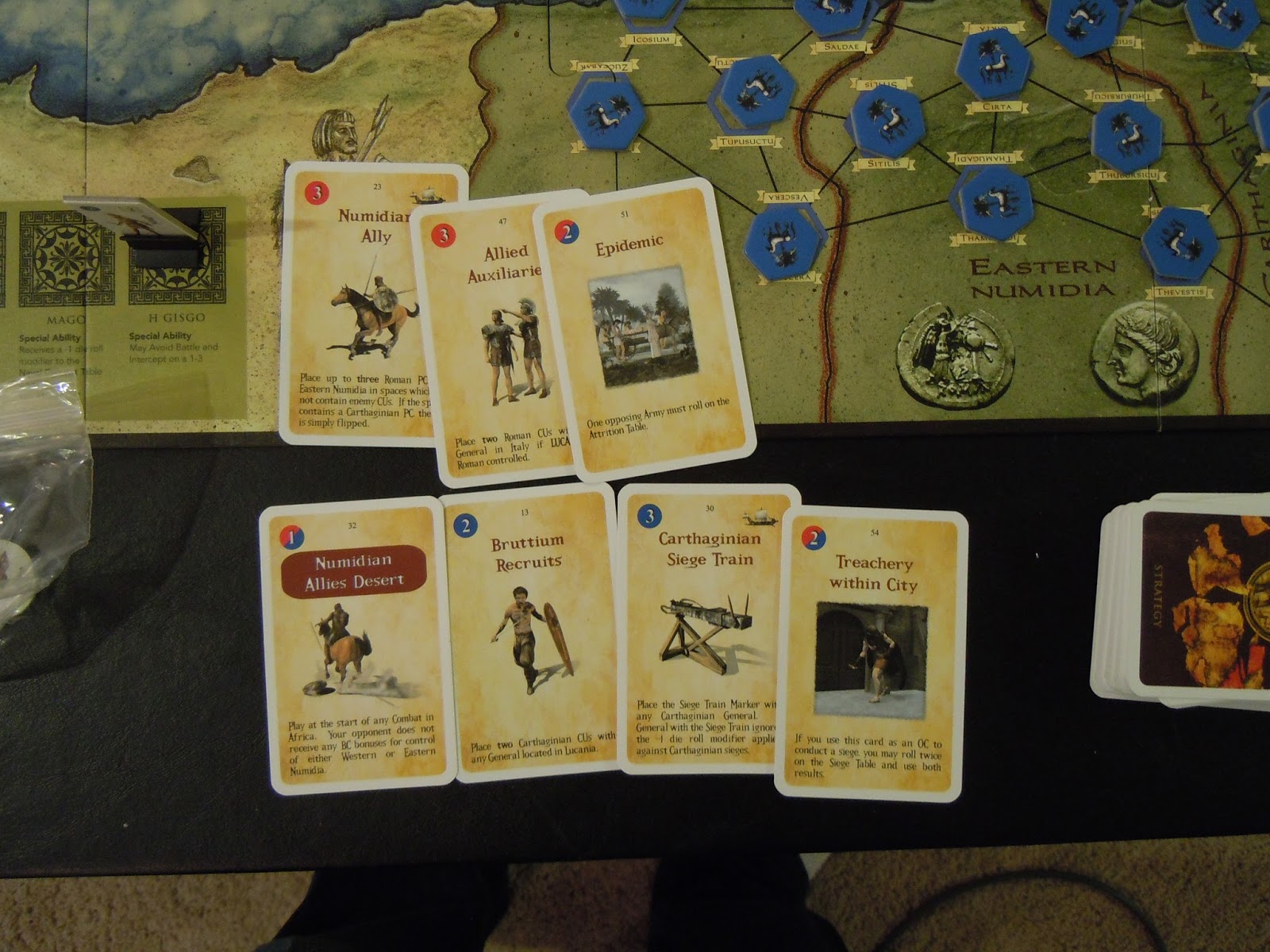
Hannibal Campaign Playtesting


I am quite new to this hobby that can take years and years to amass figures for various periods... however I've seen quite a few Carthaginians, Gauls, and Early Republican Romans massing on the fields (painting tables) of others.

Starting Setup
As I had GREAT cards for a siege...
Hannibal decides to take care of Massilia on his way, but of course a series of poor rolls [that had double bonuses!], fail and the siege ends up taking most of 218 B.C. 
Hannibal crosses the alps and due to more bad rolls and loses 20% of the force including half the elephants. Desperate for victory and reinforcements, Hannibal meets Publius Scipio larger force at the Battle of Trebbia. 
The Battle of Trebbia was a near run thing... a very near run thing.  8CU for Carthage vs 10CU for Rome (however allies and local friendly Gauls boosted Carthage's "battle cards").  At one point Publius' frontal assault almost broke the Carthaginian center (Hannibal had to make a dice roll with a 33% chance of losing the battle).  A flanking attack saved the day.  For Rome the loses were light... 10% for battle casualties and 20% for the retreat (3 CU). Carthage... another 3 CU losses, meaning Hannibal was at 50% of the numbers he started his march to Italy with.

The "Allies System" and combat losses/attrition may need to be adjusted for miniatures campaign purposes as will be seen further on.

Hannibal rolls the worst possible result for casualties. 
Battle of Mutina, 217 B.C.  Hannibal meets Publius Scipio again at the newly founded Roman Colony of Mutina. 
  Carthage CU 5 vs Roman CU 7.  Publius who had multiple battle cards to play to give him a leg up at Trebbia is out of tricks.  Hannibal, despite fewer troops, easily wins the battle and with the "double envelopment" bonus the remains of the consular legion are wiped out and Publius is gravely wounded.

Hannibal finishes what he started at Trebbia

New year and new consuls, Marcellus leads an attack into Etruria and is nearly wiped out...
 Hannibal ambushes Marcellus near Lake Trasamine Carthage 6 CU: Rome 5CU and is wiped out with only 1 CU making it off the field.

Carthage opens a new front in Sicily under Hasdrubal 
 Carthage (me)  gets great cards for negating Roman's naval supremacy and lands troops in Sicily following Syracuse's defection to Carthage.  Hasdrubal manages to wipe out Tiberius Longus in a series of victories (10 CU on each side) across Sicily compounded by the local population defecting to Cartage (long retreats through unfriendly territory are deadly).

Test run got called here in 216 B.C.

I think with some minor tweaks for converting CU to the tabletop and the battle losses table this could work and more importantly in the first few turns of the campaign the system produced a series of playable battles on the tabletop.

Monday, June 17, 2013

Empire Campaign System

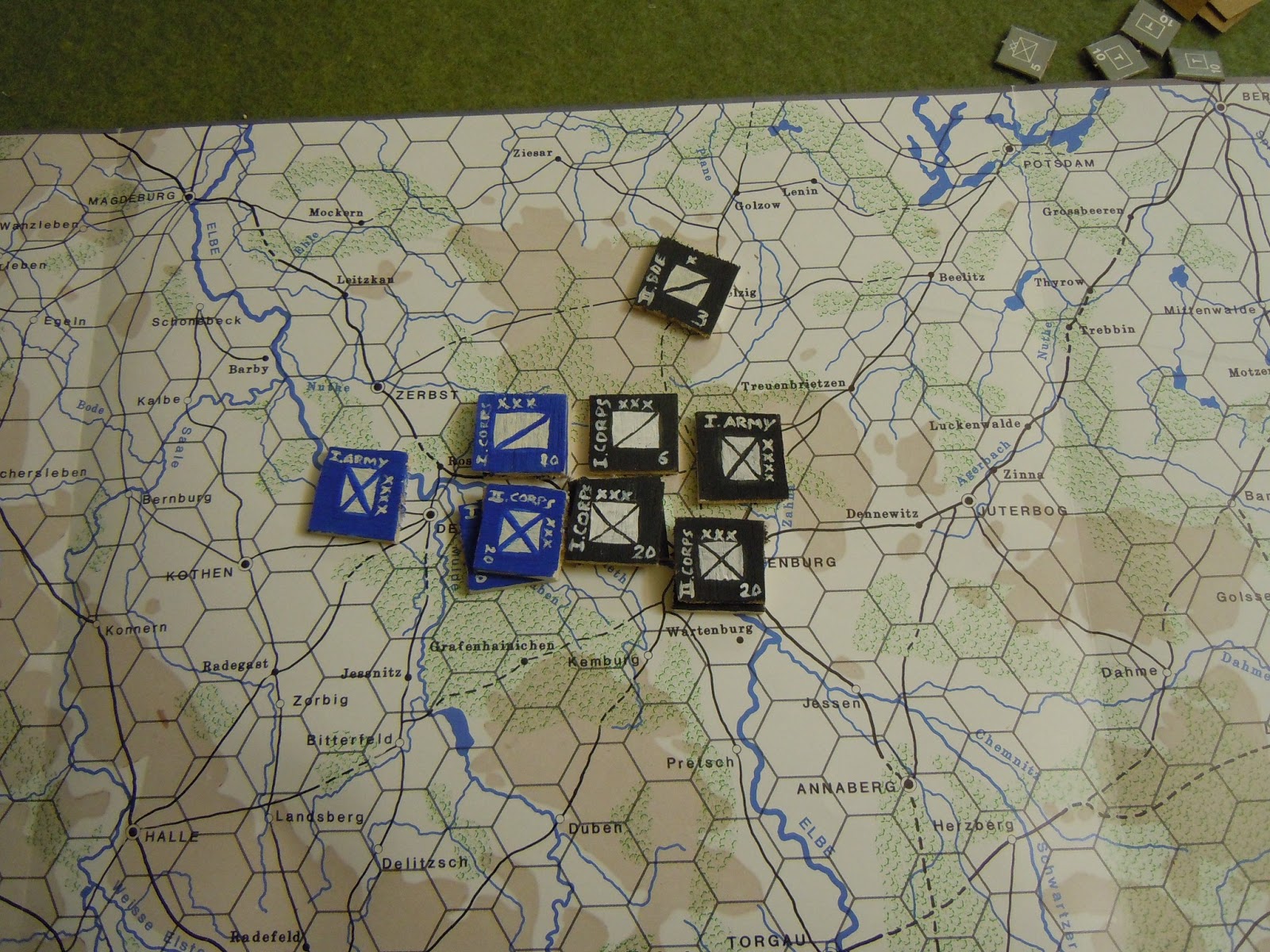
A week ago after an impromptu game I got to demo test the Empire Campaign System on a limited basis.  This is a fictional scenario with two identical forces opposing each other across the Elbe.

French Advance from Leipzig;  Prussians deployed to observe Torgau and Wittenberg
French Cavalry Crosses the Elbe; Prussians in the Dark

Prussian Light Cavalry Bde (Landwehr!) manage to observe the French Cavalry Corp.
In the fading light the Saxon Cuirassier are identified.  The French, being expert light cavalrymen manage to detect that there are cavalry out there somewhere... they think...
French push the Landwehr  Cav. Bde back
French Infantry Corps get tangled up in the bagged train of the Cavalry Corps at Dessau slowing their crossing of the Elbe.  The contact intel has reached the rest of the Prussian army and they start to concentrate.
French call it a day 9:00 p.m.;  Prussians take extra movement/fatigue and night march.
The lead Prussian infantry corps attempts to surprise and push back the Cavalry from Rosslau--and fails miserably and is forced back with light casualties.
Prussians spend the night concentrating.  A regiment has swept the left bank of the Elbe from Torgau to Wittenberg and another Brigade is sent to watch the minor road to the north that winds its way to Potsdam.
Prussians are resting off their fatigue.   The  French are waking up, eating breakfast and spend their extra movement so they can walk on the field in battle formation.  Battle Starts at 10:00 a.m.  with the French advancing upon Koswig.
A Infantry Corp and a Cavalry Corp are holding Koswig.  The  French  are fully concentrated with two Infantry Corps and one Cavalry Corp. The Prussians are playing for time.  A fairly fatigued Infantry corp will arrive at 12 noon.  (The lead Prussian Corps could have tried to get some fieldworks dug, fatiguing a LW battalion significantly, but forgot to do engineering)

Some Observations on our first go:
  • The map needs to be enlarged for easier movement (even the the small card markers get unwieldy quickly as forces concentrate
  • Paperwork will be significant and all the more reason to try to find ways to offload some of the work onto a computer
  • The movement seems to be a bit off.  For the map itself with so many rivers and streams movement might be limited to something more reasonable, however on a major road with no defiles or rivers you can march an infantry corp 30 miles a day without incurring straggling or significant fatigue that couldnt be slept off in a single night.  
    • Now a 30 mile day is certainly possible, but seems a bit much for your "average" especially since it would not trigger any straggling.  Every 4 hours of normal marching gets you 3 fatigue.  Straggling doesnt kick in until 12 fatigue.
  • Doing the campaign would require a pre-"game day" session as it would take sometime.
  • The campaign system is pretty amazing in that it covers just about everything, including disease, straggling, engineering, hospitals, trains, supply, reconnaissance 

Tuesday, June 4, 2013

How I Learned to Stop Worrying and Love the Command Failure

Our last 3 Napoleonic games have all featured command blundered that significantly altered the course of events on one of the flanks.  Many rules feature some sort of command and control system that adds in arbitrary "failures" which prevent commands from reacting (or reacting in an unexpected manner).  Often command leader failures lead to frustration--I've certainly experienced it--but I don't think a set of rules is complete without it, notwithstanding the many variations of "they're 200 yards apart of course they will advance together!"  As the title of this post suggests, I'm embraced my inner Dr. Strangelove and embraced the Command Failure.

Austrian's sitting pretty, but watching idly as their comrades are routed.
My club played two games over memorial day weekend and on our rest day in between, I was poignantly reminded of why command friction and failure is so important.  First, off a disclaimer... I have no military background nor do I have expertise as a military historian in the 18th and 19th Centuries.  However, I have had the opportunity, the pleasure, and the sometimes headache of organizing and leading small to large groups in various PvP (player vs player) MMO or FPS settings, which recently reminded me just how common command and control failure is--even when everyone involved has the equivalent of a radio strapped to their heads.

This past Saturday (between our miniature games) was a minor affair.  A skirmish between two sides of approximately 10-12 combatants each.  I was leading a slightly outnumbered group in defense, awaiting for allies to arrive.  Long story short, the allies approach is noticed by the enemy, who conveniently string themselves out chasing our allies.  I manage to redirect my force, rally them, look back and confirm everyone   was on site, then called for a "follow me".  I tear into an orchard, find the enemy's flank/rear in a perfect opportunity to divide and conquer the larger force and charge.  I quickly realize once the our foes turned to face us that the only person with me is my sub-commander/NCO (who up to this point I always had bringing up the rear ensure our coalition force remained together).  Instead of wiping out our foes we end up trading kills man for man.  The rest of my force was off in the woods chasing a lone straggler.  Command Failure.

12th IR taking advantage of Marshal Ney's command and control failures
and rolling up Girard's division. 
I've been playing PvP games for 15 years as a commander, NCO, and grunt.  I've commanded numerous skirmishes on the order of 10-75 combatants, a handful battles (often defensive sieges) closer to 300 total combatants.  I've been an NCO in battles and coalition political leader in combats of up to 1000-1500 and I've been a grunt "trigger-puller" in battles involving up to 3000 players.  More or less in everyone one of those contests the leadership/commanders job was 40% preventing internal friction from splitting up the force (and giving the enemy easy kills) and 60% worrying about whatever the enemy is doing.  (Smaller more veteran forces proportionally shifts that balance more heavily in favor of the enemy--and really takes the load off the man at the top).  Much of the cohesion issues in PvP gaming is player stupidity, desire for independent action, and quick kills.  In historical gaming/simulation our rules are attempting to model our figures putting a lot more on the line than pixels.

Which is a long way of saying I was once again reminded How I Learned to Stop Worrying and Love the Command Failure.

Thursday, May 30, 2013

Empire and Skirmish, Part II

Voltigeurs to the Advance!
I recently had nice 2.5 hour drive, which I of course used gainfully by trying to crack the Skirmish question.

After much conversation with various members of the group and some good thinking time in the car here is my proposal:

The Skirmish phase, like bombardment. represents the activities of an entire hour of combat.  Any skirmishers involved, whether they win or lose, may not issue further small arms in the tactical combat phase (except for return fire, opportunity fire or supporting defensive fire).
The Skirmish "Winners":

  • The winning skirmishers may continue to act as screens in the tactical phase or can opt to withdraw to behind the ME frontline of formed troops prior to tactical combat.
  • The winners conduct their "free shot" per rules, limited only by max weapons range.
  • The winners suppress the opposed skirmishers allowing their side to advance and bring fire at full effect upon the enemy.  
  • Skirmishers involved (integral or otherwise) may not initiate small arms. 

The Skirmish "Losers":

  • Defeated skirmishers must withdraw and take casualties per rules.  
  • Defeated integral skirmishers form up with their units and may count for Infantry mass, but cannot deploy or conduct small arms.   
  • Skirmish losses for withdrawing screens can never be less than one figure, but in all other cases skirmish losses are rounded down.

When to Use Skirmish Combat:

  • When you wish to suppress opposed enemy skirmishers so you can bring fire on opposed formed MEs and cause casualties which degrade enemy combat performance  (without skrimish combat, skirmish screens cannot be forced to retreat without charging or advancing formed troops to point blank small arms range).
  • When your skirmish screen is unopposed, but you want to close with the enemy with formed troops or otherwise get a the "free shot".  Each victorious Excellent skirmisher fires like Old Guardsmen and each victorious Good skirmisher fires like a Grenadier (Crack Line for British) at point blank range, with little risk to themselves. 

Tactical Consequences of Rule Change:

  • Integral skirmishers that are used in Skirmish combat cannot be used to "bring fire" later on in the tactical phase.  To keep the initiative the parent unit would have to move extreme range and engage in small arms.  For Non-British trained armies, a 12 casting front line would fire/receive return fire at between 72% (Old Guard) and 12% (Conscripts/Landwehr), with average being 24% (Crack/Vet Line).  British trained would fire at between 72% (Guards) and 36% (Crack/Vet.), with Conscripts and lower being unable to return fire.  

This proposed change attempts to reconcile both camps.  Skirmish combat is retained, but integral skirmishers do not get multiple bites at "skirmish combat" per hour. No changes are made to the ability to screen for troops engaged in skirmish combat and a bright-line rule is established for what to do with integral skirmishers when they lose.

 I've added the option to withdraw behind the front line at the end of skirmish combat to clear the field so that MEs may bring fire more easily and keep the initiative. I also clarified how to deal with fractional casualties (as skirmish combat gives casualties at a flat % of a force).

Monday, May 27, 2013

Empire and Skirmish

My gaming club has had difficulty selecting a ruleset for Napoleonics.  Part of it comes down to Simulation vs Game.  Part of it is having to rebase or double (or triple) the number of figures needed (and associated expense).  And Part of the difficulty is the reputation of Empire (whether correctly or incorrectly) for being overly in favor the French.

After trying Empire III (for others amongst the group its re-learning) it quickly became clear that 1) the rules are not always clear and lack examples and 2) the charts/flow charts are clunky taking up a lot of space and do not always contain all the information/exceptions without reference to the rulebook.  At times it seems like Empire V is needed as reference help interpret what was meant in Empire III (were using III as its less detailed/more simplified)

All of which is background to how to handle skirmishing.  Can one cavalry regiment on an entire attack front neutralize skirmishers? Do retreating integral skirmishers that must "withdraw" have to stand down for the entire hourly round per the rules?  Should they be able to fallback to their units?  Can they count for infantry mass in close combat? Is allowing integral skirmishers to fire each impulse (1-3 times per round) on top of the skirmish combat round to much? (potentially allowing a single regiments skirmish company to cause up to 6 castings of casualties (360 men) per hour.

I've read 5 or so threads on the Yahoo EmpireNapoleonics Groups that go back and forth on this.  Here are just a few of the recurring thoughts:

*Empire V is terrible and Empire III's skirmish combat got it right!
*Empire is a Corps/Divisional game, the actions of skirmishers should be abstracted! and it Goes Faster!
*What do you do about integral skirmishers that must withdraw, what can they do as part of their unit for the rest of the hour?
*What should be the width of the skirmish determination be (this apparently changes whether you use Emp. III, Rep. to Emp., or Emp V.)

I'm not sure what the solution is as of yet.  The rules seem to work well for non-integral skirmishers, e.g. entirely unformed units.  They go out and do their thing at the beginning of the round and if they lose they stand down for an hour.  If they win they continue to screen the units behind, tie up enemy artillery etc. Without the skirmish combat round there is no "driving off" the enemy skirmishers, each side with skirmishers retains all the tactical advantages of them.  However, with integral skirmishers you run into issues with 1) what do with them when they loose; 2) does it best reflect skirmish conflict for both a skirmish round and then integral skirmishers being used tactically;  and 3) does #2 led to integral skirmishers being everywhere all the time beyond what is properly reflected in a single hourly round.

 At the moment I'm almost inclined to the Empire V, solution.  There was an interesting quote attributed to the Great S. Bowden on one of the threads to affect of "the fate and actions of a single battalion are of no consequence on the scale of Empire".

I expect there will be more discussion on this to come.